 The City of Ur
Ancient city in Mesopotamia, in what today is southern Iraq. Ur existed for a period of approximately 3,700 years. Today only ruins are left, and they lie in the desert landscape of al-Hajar. Originally, Ur was in a fertile area, near the outlet of the Euphrates river, and on what was the coast of the Arab Gulf a few thousand years ago. Today, Ur lies about 220 km west of the sea.
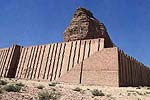
Ur had an important role as a religious cult centre, and the Sumerian Moon god Nanna and the Babylonian equivalent Sin were worshipped here. This cult was also the reason for erecting the impressive ziggurat, from which much still exist (see photo). Due to its position, near the river and the sea, Ur was central in foreign trade of its time, and used Dilmun (now Bahrain) as transit harbour.
HISTORY
4000 BC: The first settlements, by a people we now call Ubaidis (we do not know what they called themselves, and have given them name from the modern village of Tellu l-Ubaid).
29th century BC: Ur develops into becoming one of the richest cities in Sumer.
27th century BC: The 1st dynasty of Ur is established by Mesanepada.
Around 2100 BC: The 3rd dynasty is founded by Ur-Nammu, who revives the empire of Sumer and Akkad. He proved to be a social reformer, and he also collected a law system that predated the more famous Code of Hammurabi.
21st century BC:
Ur-Nammu and his son Shulgi has the ziggurat of Nanna built, along with other great temples.
Around 2000 BC: The Elamites destroy Ur, and capture the king.
2nd millenium BC: Ur becomes first part of the kingdom of Isin, then Larsa. During this period, the temples were restored. Later Ur became part of Babylonia. Through this time, the city prospered and remained an important religious centre.
6th century BC: The Babylonian king, Nebuchadrezzar 2, has most of Ur rebuilt. King Nabonidus increases the height of the ziggurat to 7 stages.
4th century BC: The coast line east of Ur starts to develop due to silting and elevation, and the Euphrates changes its course. As a result, the strategic position of Ur declines and the city's agricultural hinterland becomes poorer. Eventually, these changes would lead to depopulation and final abandonment of Ur.
1855 AD: The first excavation starts by an initiative of the British consul. The ziggurat of Nanna is partly uncovered.
1918-19, 1922-34: Excavations led by the British Museum, that uncover the ziggurat completely together with the rest of the temple area. The royal cemetary with enormous treasures is also uncovered.